
EASTON, Md — Maryland has made significant progress in defining the scale of its housing challenge. The state has documented substantial unmet housing need, established housing production targets for every jurisdiction, expanded access to housing data, enacted new housing policies, and increasingly encouraged counties and municipalities to remove barriers to residential development.
Those efforts have helped establish an important statewide imperative: Maryland needs more housing. But they leave local decision-makers with a more difficult question that ultimately determines whether those efforts succeed.
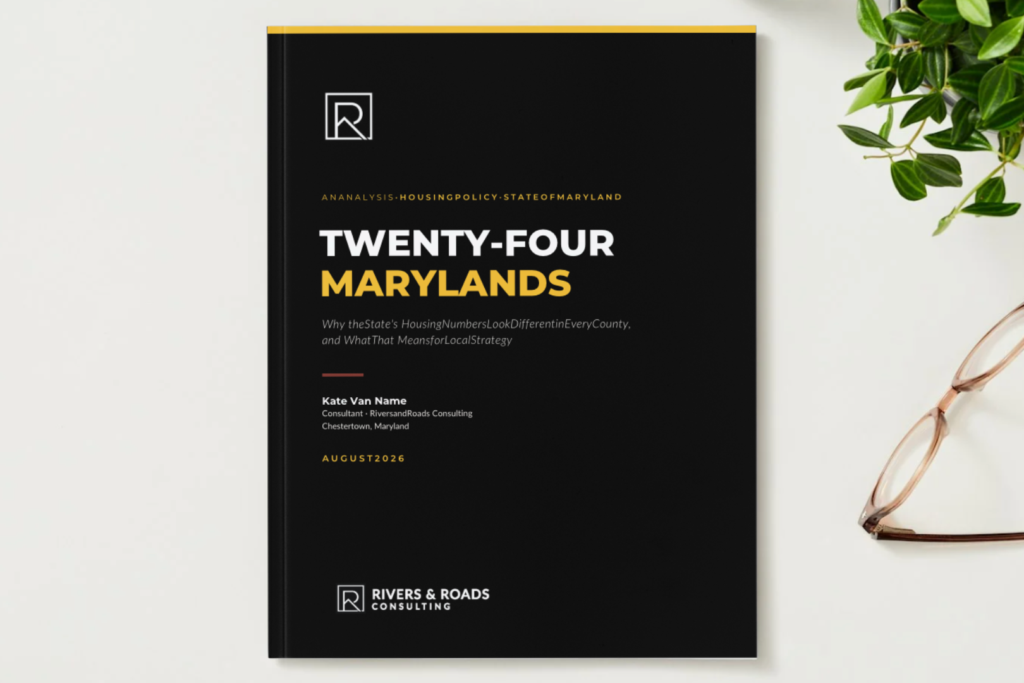
CLICK HERE TO DOWNLOAD THE ANALYSIS
What housing problem, specifically, is each community trying to solve?
That question is at the center of Twenty-Four Marylands: Why the State’s Housing Numbers Look Different in Every County, and What That Means for Local Strategy, a new statewide housing policy analysis released by Rivers & Roads Consulting and authored by consultant Kate Van Name.
The analysis examines Maryland’s 23 counties and Baltimore City through a common framework, bringing together housing prices, household incomes, local wages, migration, commuting patterns, housing stock, age, homeownership, development activity, housing production targets, and other indicators that are too often considered separately. The result is a fundamentally different way of approaching Maryland housing strategy: not by beginning with a preferred policy intervention, but by first determining the constraint that is actually shaping the local housing market.
The central finding is straightforward but consequential. Maryland may have a statewide housing challenge, but it does not have a single housing market. The conditions driving housing affordability in Howard County are different from those shaping Cecil County. The forces affecting Talbot County are different from those in Baltimore City. Allegany County, Frederick County, Queen Anne’s County, and Prince George’s County may all appear in the same statewide housing conversation, but the analysis finds that they arrive there through very different combinations of income, housing supply, demand, employment, migration, demographics, and market pressure.
For county executives, commissioners, municipal leaders, planning and housing officials, economic development organizations, housing authorities, developers, employers, and others responsible for shaping local housing policy, that distinction is critical. A statewide housing target can establish an important benchmark for production. It cannot, on its own, determine what kind of housing a community needs, which households are being squeezed, why the market is failing to meet that need, or which policy intervention is most likely to change the outcome.
Maryland’s Housing Crisis Looks Different in Every County
The premise behind Twenty-Four Marylands becomes clearer when Maryland is read county by county rather than as a statewide average.
In Anne Arundel, Howard, and Montgomery counties, housing prices have moved beyond what even comparatively strong household incomes can comfortably support. These are not fundamentally low-income housing markets. They are high-cost markets where strong earnings have increasingly failed to keep pace with the price of entry.
A different dynamic appears in Frederick, Queen Anne’s, Calvert, Carroll, Charles, and Harford counties. In these jurisdictions, metropolitan income is increasingly influencing local housing demand. Residents may earn wages in Washington, Baltimore, Annapolis, or other employment centers and carry those incomes into housing markets farther from the job itself. The result can be a local housing market that prices increasingly for the commuter rather than the worker whose paycheck originates within the county.
Talbot, Worcester, Kent, and Garrett counties present another variation. There, second-home activity, resort demand, retirement migration, and wealth generated outside the local economy can influence housing prices even though the year-round workforce earns substantially less. A local employer may be hiring against one wage structure while employees are searching for housing in a market partially priced by households whose income is earned elsewhere.
The analysis identifies still different challenges in counties where housing appears comparatively affordable. In Allegany, Caroline, Dorchester, Somerset, Washington, Wicomico, and other thinner markets, the central issue may involve household income, housing condition, job growth, or demand rather than simply the cost of newly constructed housing. Cecil County illustrates why even those categories require caution: the county recorded Maryland’s fastest employment growth between 2019 and 2025, creating a housing challenge shaped less by weak demand than by the risk that housing production will fail to keep pace with an expanding workforce.
These are not minor variations around a common problem. They are different housing-market conditions that can require different priorities, different partners, different investments, and different public policies.
Why an Accurate Housing Market Diagnosis Matters
The distinction between a statewide housing shortage and a local housing diagnosis is more than academic. Local governments are making consequential decisions now about zoning, density, infrastructure, development review, public land, fees, incentives, subsidies, and residential growth. Those decisions can shape a community for decades.
If the diagnosis is wrong, however, a jurisdiction can take significant action without materially improving the problem it intended to solve.
A county can approve more housing and still produce little that its local workforce can afford. A jurisdiction can meet a numerical housing production target while adding units concentrated at price points that remain beyond the reach of households experiencing the greatest pressure. A lower-cost community can focus heavily on incentivizing new construction when deteriorating existing stock, weak employment, or limited demand is the more immediate threat to housing stability.
The same risk applies to public investment. Infrastructure can be extended toward places that produce housing but not the housing type a community actually lacks. Subsidies can be deployed to overcome a financing gap when the more consequential obstacle is development regulation, land availability, or market demand. Zoning can be liberalized in places where zoning is not the primary reason housing is failing to materialize.
None of those interventions is inherently misguided. The problem arises when the intervention becomes the strategy rather than a tool selected in response to an established diagnosis.
That is one of the primary arguments of Twenty-Four Marylands: before a jurisdiction decides which housing lever to pull, it should understand why that lever needs to move.
Maryland Housing Affordability Is Ultimately a Question of Fit
The analysis approaches housing affordability as a relationship rather than as a single number. Home prices matter, but a $400,000 home has a very different meaning in a county where households routinely earn $150,000 than in one where local wages support household incomes far below that level. Income matters, but high incomes do not necessarily produce affordability when housing prices have risen faster still.
The relevant question is the fit between the two.
Twenty-Four Marylands therefore reads household income and housing prices alongside the wages generated by local jobs, the income of households moving into a county, rental costs, homeownership rates, housing stock, and cost burden. Each measure answers a different question, and the analysis argues that local strategy becomes clearer only when those measures are considered together.
That distinction is particularly important in Maryland because housing markets routinely cross jurisdictional boundaries. Workers may earn their income in one county and purchase a home in another. Washington-area wages influence markets well beyond the Capital Beltway. Annapolis and broader metropolitan incomes cross the Bay Bridge. Cecil County functions within a housing and employment market that extends into Delaware and Pennsylvania. Resort and second-home buyers can influence housing markets without participating in the local labor market at all.
A county line may determine who adopts the zoning ordinance or collects the property tax, but it does not necessarily determine the market.
For local leaders, that means an effective Maryland housing strategy must account for the economic geography surrounding the community as well as the conditions inside it. The household bidding on the next home may not yet live in the county, and the wage setting that household’s purchasing power may not be earned there.
Housing Supply Depends on Whether the Housing Ladder Can Move
One of the more significant findings in Twenty-Four Marylands is that the amount of housing physically present in a community is not necessarily the same as the amount of housing functionally available to the market.
Maryland’s aging population illustrates the distinction. Much of the housing conversation around older adults understandably focuses on aging in place and senior housing. The analysis identifies an additional market consequence: in many communities, older homeowners who might otherwise move from a larger family-sized home have few appropriate places to go.
The missing option is frequently not institutional senior housing. It is a smaller, single-level, accessible, low-maintenance home located within the same community—a smaller detached home, townhouse, condominium, or comparable housing form that allows an older household to remain nearby while reducing the burden of maintaining a larger property.
When those choices are absent, households remain where they are. That decision may be entirely rational for the homeowner, but it has consequences farther down the market. The larger home does not return to inventory, another family cannot purchase it, and an additional point of movement through the housing system disappears.
The challenge, therefore, is not simply whether enough housing exists. It is whether the available stock allows households to move as their incomes, family structures, and needs change.
This is also where the analysis offers a more useful interpretation of the frequently discussed “missing middle.” The problem in many Maryland communities is not necessarily the complete absence of homes within a particular value range. The more important gap can be housing type. A county may appear to have a substantial number of homes between $200,000 and $400,000 while offering very few townhouses, condominiums, duplexes, smaller detached homes, or other forms that provide an alternative to a traditional single-family house.
A housing market can therefore appear balanced by price and remain constrained by form. Understanding that distinction can materially change what a county chooses to encourage.
Maryland Housing Strategy Must Address the Full Housing Spectrum
The analysis organizes housing using HUD’s eight broad income-based rungs, spanning crisis and deeply affordable housing through affordable, workforce, attainable, market-rate, and luxury housing. The purpose is not to replace established federal affordability classifications, but to help decision-makers see housing as a connected market in which pressure at one level can affect households elsewhere.
Maryland’s deeply affordable housing needs remain substantial, particularly for extremely low-income renters, households experiencing severe cost burden, older renters, and residents requiring supportive housing or rental assistance. Those needs require direct attention and, in many cases, subsidy.
At the same time, a community can also experience significant pressure among households that fall outside many traditional housing programs. Teachers, nurses, tradespeople, public safety employees, service-sector workers, young professionals, and other households may earn too much to qualify for deeply subsidized housing while remaining unable to purchase what their local market is producing.
Those households occupy an important part of the housing system because they are often the next renters seeking ownership, the workforce local employers are trying to retain, or the families attempting to establish longer-term roots in a community. When that portion of the housing ladder becomes inaccessible, the effects extend beyond housing affordability into workforce retention, economic competitiveness, population growth, and household wealth creation.
A strong local housing strategy therefore cannot be reduced to choosing between “affordable housing” and “market-rate housing.” It must understand where pressure exists across the spectrum and determine which rungs are missing, undersupplied, inaccessible, or no longer moving.
Local Housing Policy Tools Should Follow the Local Housing Problem
Across Maryland, local governments are already grappling with many of the same policy questions. Should zoning allow greater density? Should more housing types be permitted by right? Can accessory dwelling units meaningfully contribute to supply? Are development review timelines adding unnecessary costs? Should impact fees change? Can publicly owned land support housing? Where should water and sewer infrastructure be expanded? When should public subsidy or tax incentives be used?
These are legitimate questions, and the analysis does not attempt to provide one statewide answer to them. Instead, it reframes how those questions should be approached.
Zoning reform is useful when zoning is constraining the housing a market needs and can otherwise support. Increased density can improve project economics where land cost is a significant barrier. Infrastructure expansion can unlock production where development is otherwise feasible, but capacity is absent. Subsidies can close a genuine affordability gap between what households can pay and what housing costs to produce. Public land can reduce a major development expense when land cost is the problem.
The strategic value of each tool depends on the constraint.
A jurisdiction that begins by selecting the tool risks designing its housing policy around the intervention rather than the outcome. A jurisdiction that begins with the market can instead ask a more disciplined set of questions: Which households are affected? What housing is missing? Why is the market not producing it? What prevents existing housing from circulating? Which institution controls that constraint? What public or private intervention would change the economics?
Only then does the appropriate combination of zoning, development process, financing, infrastructure, incentives, public land, employer participation, or subsidy become clear.
This is the difference between being active on housing and having a housing strategy.
Housing Strategy Is Economic Development Strategy
The implications extend well beyond housing departments and planning commissions because housing sits at the intersection of nearly every major issue affecting the long-term competitiveness of Maryland communities.
Employers cannot sustainably expand if workers cannot find housing within a reasonable distance of available jobs. Communities struggle to retain younger households if those households see no viable path from renting to ownership. Older residents may leave entirely when downsizing within their community is impossible. Local businesses feel the effects when workforce shortages constrain operations, while school systems, hospitals, public safety agencies, and other essential employers compete for employees in the same housing market.
Housing also remains one of the primary mechanisms through which households build long-term wealth. When a workforce household remains locked out of ownership for an extended period, the consequence is not limited to monthly housing costs. It includes years of foregone equity and, potentially, a substantial reduction in the wealth ultimately transferred to the next generation.
Local governments face another side of the equation. Housing also creates assessed value, influences infrastructure demand, and affects the revenue available to support public services. The housing a community needs socially, economically, and demographically may not always be the housing the fiscal structure most strongly rewards.
A meaningful housing strategy must acknowledge these tradeoffs rather than treating them as separate conversations. Housing policy is simultaneously workforce policy, economic development policy, demographic strategy, land-use policy, infrastructure planning, fiscal policy, and household wealth strategy.
What Maryland Counties Should Determine Before Choosing a Housing Solution
Twenty-Four Marylands does not conclude by prescribing the same set of recommendations to every county. Instead, it identifies the questions that local governments should be able to answer before committing to a strategy.
A jurisdiction should understand who is moving into the community and what those households earn. It should know what the local workforce earns, where residents actually work, what housing those incomes can support, and how those figures compare with the homes and rents available in the market.
It should understand its housing stock not simply by unit count, but by price, tenure, type, age, condition, and availability. It should know which households are cost-burdened, where the most significant gaps appear along the housing spectrum, whether older households have viable downsizing opportunities, and whether the community’s existing stock is circulating in the way policymakers assume.
Local leaders should also understand what is already in the development pipeline, where infrastructure can accommodate growth, what the state’s production target means in the context of actual local permitting, and which constraints are controlled by the county, municipalities, the state, federal programs, employers, lenders, or private developers.
The housing analysis provides a preliminary assessment for every Maryland jurisdiction, but deliberately stops short of presenting those assessments as final local strategies. The statewide analysis is intended to identify where the evidence points and, equally important, where local leaders should investigate further.
That deeper work is where strategy begins.
The Next Step for Maryland Housing Is Moving From Data to Strategy
Maryland has established an increasingly sophisticated understanding of the scale of its housing challenge. The state has set production targets, assembled substantial data, changed laws, created incentives, and placed housing firmly on the public policy agenda.
The next phase should be equally disciplined.
Local governments now need to determine which housing outcomes matter most in their communities, what is preventing those outcomes from occurring, and which combination of public and private interventions can realistically change the market. That work requires counties to move away from conducting typical housing needs assessments that document a shortage and end with a familiar menu of recommendations, and toward an actionable housing strategy that connects market conditions to policy choices, implementation responsibilities, financing, infrastructure, development economics, and measurable outcomes.
That is the work Rivers & Roads Consulting is positioned to help communities undertake.
Twenty-Four Marylands provides a statewide framework and a preliminary diagnosis. For county and municipal leaders, the next opportunity is to take that framework deeper: testing the assumptions against local data, examining the development pipeline and housing stock in greater detail, engaging employers and community stakeholders, identifying the constraints that matter most, and translating those findings into a strategy that can actually be implemented.
We encourage Maryland leaders to read the analysis, find their jurisdiction, examine the preliminary conclusions, and consider whether their current housing policies are responding to the problem their local market actually has.
For communities ready to move beyond the question of how much housing is needed and begin answering the more consequential questions of what should be built or preserved, for whom, where, why, and through which interventions, Rivers & Roads Consulting is ready to help formulate the strategy that comes next.